Patriotic Power Anthems: Songs to Celebrate America – And Remember Our Resilience
The Fourth of July is a day for celebration, for fireworks and barbecues, a joyous expression of the freedoms we cherish. But it's also a day for reflection, a moment to remember the profound journey of our nation, including the times when our spirit was tested. In those moments, when shadows have fallen over our collective heart, it's often music that rises to meet us, offering solace, strength, and a renewed sense of unity.
Today, as we gather with loved ones, I want to talk about two anthems that, for me, have always transcended mere celebration. They are songs that speak to the very core of what it means to be American, particularly in times of trouble, reminding us of our shared resolve and enduring hope.
"America the Beautiful": A Timeless Ode to Our Enduring Spirit
First, there's "America the Beautiful." Its sweeping verses, penned by Katharine Lee Bates after being inspired by the majestic views from Pikes Peak, paint a vivid picture of our nation's physical grandeur – 'amber waves of grain,' 'purple mountain majesties.' But beyond the scenic beauty, the song's true power lies in its aspirational prayer for a nobler, more just nation.
In moments of national sorrow or uncertainty, "America the Beautiful" isn't just a description; it becomes a profound affirmation. It reminds us of the inherent goodness and the foundational ideals upon which this country was built. When we hear 'God shed His grace on thee,' it's a plea, a hope, and a reminder that even in despair, there's a higher purpose and a collective strength to draw upon. It's a song that speaks to our ideals, urging us to live up to the promise of America, even when the path seems difficult.
For fellow musicians or anyone who appreciates instrumental interpretations, I'm proud to share my own arrangement of this beautiful anthem for Alto Saxophone and Piano.
"God Bless the U.S.A." by Lee Greenwood: A Beacon of Unity in the Darkest Hours
And then there's Lee Greenwood's iconic "God Bless the U.S.A." If "America the Beautiful" is our poetic prayer, "God Bless the U.S.A." is our rallying cry, a song that wraps us in a comforting blanket of shared patriotism. It’s a tune that resonates deeply with pride for our flag, our soldiers, and our collective journey.
For many of us, this song is inextricably linked to a time when our nation faced one of its most unimaginable tragedies: September 11, 2001. I remember that day with vivid clarity. I picture the Twin Towers, once standing tall, shining symbols of our country and the New York skyline, a testament to American ambition and ingenuity. It's hard to believe that these beautiful monuments have been gone for almost a quarter of a century now. Twenty-four years later, the memory of that morning still evokes a profound sense of loss, yet also an incredible surge of resolve.
On that tragic day, and in the weeks and months that followed, "God Bless the U.S.A." wasn't just played; it was felt. It was on repeat everywhere you went – on the radio, at memorial services, in the background of news reports. Its lyrics, 'And I'm proud to be an American, where at least I know I'm free,' and 'there ain't no doubt I love this land, God bless the U.S.A.,' became an immediate anthem of resilience. They spoke of unity, of standing together in the face of unspeakable horror, of finding strength in our shared identity.
Today, as we look at the One World Trade Center building standing tall and proud in their place, a symbol of rebirth and indomitable spirit, the message of "God Bless the U.S.A." remains as vital as ever. We need the elements of unity and strength, spoken so clearly in its enduring lyrics, now more than ever. These songs remind us that even when tested, the American spirit endures, ready to rebuild, to heal, and to look towards a brighter future.
As we celebrate this Fourth of July, let these anthems not just be background music, but powerful reminders of our nation's journey, its resilience, and the unity that always sees us through. What songs speak to you in moments of national pride or reflection?
One of my Latest Music Compilations
In this blog post, I show you one of my latest music compilations. It features music compositions that I’ve written from 2009 to present. I plan to do more in the near future! Enjoy!
Composing in Aeolian Mode: Embracing Melancholy and Reflection
Just as Ionian mode is our primary gateway to major tonality, Aeolian mode is the foundation of natural minor. While you are undoubtedly familiar with its sound as the "natural minor scale," composing intentionally in Aeolian allows you to tap into a specific quality of melancholy, introspection, and somber reflection, distinct from the dramatic tension of harmonic minor or the bittersweetness of Dorian.
This post will guide you through practical strategies for composing with Aeolian mode, helping you embrace its inherent pathos and create music that is genuinely expressive of sadness, longing, or thoughtful resignation.
The Aeolian Identity: Natural Minor's Quiet Strength
Aeolian mode (W-H-W-W-H-W-W) is characterized by its minor third, minor sixth (b6), and minor seventh (b7). Unlike harmonic minor, it lacks a raised leading tone, meaning there's no strong half-step pull to the tonic from below. This absence of the leading tone contributes to its characteristic feeling of resignation or gentle sadness rather than a dramatic, driving tension. It simply is – a quiet contemplation of sorrow or a gentle reflection.
When composing in Aeolian, your primary goal is to leverage this natural, unforced minor quality to communicate introspection, lament, or a pervasive sense of melancholy.
Melodic Strategies in Aeolian
Aeolian melodies often feel lyrical, sometimes descending, and embody a natural, flowing sadness.
Emphasize the b3, b6, and b7: These are the defining scale degrees of Aeolian.
The b6 (minor sixth) is particularly important for distinguishing Aeolian from Dorian. Melodies that descend to or linger on the b6 (e.g., F in A Aeolian) will clearly establish the Aeolian sound.
The b7 (minor seventh) reinforces the minor quality and avoids the leading tone's strong pull, contributing to the resigned feel.
Example: In A Aeolian, a phrase might highlight F and G (b6 and b7) as it descends to A.
Stepwise Motion and Descending Lines: Aeolian melodies often favor stepwise motion, creating smooth, vocal-like lines. Descending contours are particularly effective for conveying sadness or a sense of winding down.
Avoid the Raised 7th: Unless you are intentionally shifting to harmonic minor for a specific dramatic effect (e.g., at a strong cadence), keep your melodies on the natural 7th degree (G in A Aeolian). This maintains the characteristic Aeolian sound.
Use for Vocal Writing: Aeolian mode is particularly well-suited for setting text with a melancholic or reflective tone, as its natural melodic flow and lack of strong leading tone tension feel very organic.
Harmonic Strategies in Aeolian
Aeolian harmony is characterized by the natural minor triads and the absence of a naturally occurring major dominant chord with a leading tone.
Prioritize the i, iv, and v Chords: These are your core harmonies. The i (tonic minor), iv (subdominant minor), and v (minor dominant) are all diatonic to Aeolian and form stable relationships.
Example: In A Aeolian, Am - Dm - Em - Am (i - iv - v - i) is a very characteristic progression.
Why it works: The Dm (iv) and Em (v) chords both contain the b6 (F) and b7 (G) respectively, clearly defining the Aeolian sound.
Utilize the bIII (Major III) and bVI (Major VI) Chords: These are also common and contribute to the Aeolian sound.
bIII (C major in A Aeolian): Often used as a mediant harmony.
bVI (F major in A Aeolian): Can provide a gentle shift in color, often followed by bVII or V (minor) leading back to i.
Example: Am - Fmaj - Gmaj - Am (i - bVI - bVII - i). This progression is very common in folk and pop music.
The bVII (Major VII) Chord: This chord (G major in A Aeolian) is very common. It often acts as a weaker dominant substitute or as a subtonic, leading smoothly back to i.
Contrast: This contrasts with the V (major) of harmonic minor. The Gmaj - Am progression sounds less forceful and more resigned than E7 - Am.
Avoid the Harmonic Minor Raised 7th (G# in A minor): Unless you are making a deliberate choice to borrow from harmonic minor for a stronger dominant function, stick to the natural 7th. This means your V chord will typically be a minor v (Em in A Aeolian), not a major V (E major).
Modal Cadences:
i - iv - i
i - v - i
i - bVII - i These are characteristic Aeolian cadences. Authentic cadences can still occur (V-i), but often the V will be minor, or the resolution less forceful due to the natural 7th.
Common Pitfalls to Avoid
Sounding Like Harmonic/Melodic Minor: The key is to consciously avoid the raised 7th (leading tone) unless you deliberately want its specific dramatic effect. If you find yourself consistently adding a raised 7th, you're likely drifting into harmonic minor.
Lack of Resolution: Because the leading tone is absent, some find Aeolian less conclusive. Use repetition of the tonic, clear melodic phrasing, and rhythmic emphasis on the tonic to ground the mode.
Overly Somber: While it's a minor mode, ensure there's enough melodic and harmonic movement to maintain interest. Vary textures and dynamics.
Mini-Exercise: "Autumn's Farewell" (Aeolian String Trio Sketch)
Objective: Compose a short (approx. 1.5 - 2.5 minute) piece for string trio (Violin, Viola, Cello) in E Aeolian.
Mood: Melancholy, reflective, a sense of quiet sadness or nostalgia. Imagine the slow, gentle falling of leaves in autumn.
Key/Mode: E Aeolian (E-F#-G-A-B-C-D).
Characteristic Note: C (flat 6th) and D (flat 7th).
Instructions:
Melody: Create a lyrical, flowing melody for the violin, emphasizing the C natural (b6) and D natural (b7), perhaps through descending stepwise motion or gentle suspensions.
Harmony/Voice Leading: The viola and cello provide harmonic support. Focus on Em (i), Am (iv), Bm (v), and Cmaj (bVI), Dmaj (bVII) chords. Ensure smooth voice leading between all three instruments, avoiding parallel octaves/fifths.
Texture: Start with a sparse texture, perhaps just violin and cello, then gradually add the viola. Explore sustained chords and gentle arpeggios.
Dynamics: Keep dynamics generally soft (p to mp), with subtle swells and gradual decrescendos.
Form: A simple through-composed form, allowing the mood to unfold naturally.
Play your piece back. Does the absence of a sharp 7th create a specific kind of contemplative sadness? Does it truly evoke the quiet resignation of autumn?
Conclusion
Aeolian mode is more than just "natural minor"; it is a distinct expressive voice capable of conveying deep melancholy, quiet reflection, and profound sadness without resorting to the sharp edges of harmonic minor. By consciously highlighting its characteristic flat 6th and flat 7th, both melodically and harmonically (emphasizing iv, v, bVI, and bVII chords), you can effectively compose pieces that resonate with a raw, authentic sense of lament or thoughtful introspection. Embrace its inherent subtlety and discover the quiet power within this foundational mode.
The Building Blocks of Melodic Embellishment: Revisiting Diatonic Non-Chord Tones
As composers, we often spend a lot of time focusing on chords – their types, progressions, and functions. And rightly so; harmony is the backbone of much of our music. However, melody is the voice, the storytelling element that truly captures the listener's ear. And the secret to crafting compelling, fluid, and emotionally resonant melodies often lies not just in the chord tones (notes belonging to the underlying harmony), but in the strategic use of non-chord tones (NCTs), also known as non-harmonic tones or embellishments.
Before we dive into the exciting world of chromaticism, it's essential to have a crystal-clear understanding of the fundamental diatonic non-chord tones. These are the melodic "spice" that adds flavor, nuance, and forward motion to your lines, even when strictly confined to a single key. Mastering them diatonicallly is the prerequisite for truly impactful chromatic embellishment.
Think of it like sketching. You first learn to draw basic shapes and lines (chord tones). Then, you learn to add subtle shading and contour to make those shapes more lifelike (non-chord tones). Only then are you ready to introduce vibrant, contrasting colors (chromaticism).
Let's revisit these essential melodic embellishments:
1. Passing Tones (PT)
The passing tone is perhaps the most fundamental and intuitive non-chord tone. It acts as a bridge, smoothly connecting two consonant chord tones by stepwise motion in the same direction.
Definition: A non-chord tone approached by step and left by step in the same direction.
How it Works: You have two chord tones, say C and E in a C major chord. A D can be a passing tone, smoothly connecting C to E (C-D-E). The D is not part of the C major chord, but it "passes" through.
Types:
Ascending Passing Tone: Moves up from one chord tone to another (e.g., C-D-E over a C major chord).
Descending Passing Tone: Moves down from one chord tone to another (e.g., E-D-C over a C major chord).
Placement: Usually occurs on a weaker beat or unaccented part of the measure, contributing to fluidity rather than strong emphasis.
Purpose: Primarily to create smooth melodic flow and a sense of forward motion. It fills in gaps, preventing melodies from sounding too angular or "blocky." It makes melodies more singable and natural.
Example: In C Major, over a C major chord (C-E-G), if your melody moves from C up to E, inserting a D (C-D-E) is a passing tone. If it moves from G down to E, inserting an F (G-F-E) is a passing tone.
2. Neighbor Tones (NT)
The neighbor tone (also called an auxiliary tone) creates a subtle ornamentation by moving away from a chord tone by step and immediately returning to that same chord tone. It acts like a little decorative "wiggle" around a stable note.
Definition: A non-chord tone approached by step and left by step in the opposite direction, returning to the original chord tone.
How it Works: You have a chord tone, say C in a C major chord. A neighbor tone would move to D (upper neighbor) and immediately back to C (C-D-C), or to B (lower neighbor) and immediately back to C (C-B-C).
Types:
Upper Neighbor Tone: Steps up from a chord tone and returns (e.g., C-D-C over a C major chord).
Lower Neighbor Tone: Steps down from a chord tone and returns (e.g., C-B-C over a C major chord).
Placement: Like passing tones, often occurs on a weaker beat.
Purpose: To add gentle melodic embellishment, a mild tension and quick release, and subtle rhythmic interest. It makes a melody feel less static, even if it's essentially hovering around a single chord tone.
Example: In C Major, over a C major chord, if your melody has a sustained E, moving to F then back to E (E-F-E) uses an upper neighbor. Moving to D then back to E (E-D-E) uses a lower neighbor.
3. Suspensions (Sus)
Suspensions are among the most emotionally rich non-chord tones. They create a beautiful sense of lingering tension and yearning by holding onto a note from a previous chord into a new chord, where it becomes a dissonance, before finally resolving by step (almost always downwards) into a consonant chord tone.
Definition: A chord tone that is prepared (played as a consonant note in the preceding chord), suspended (held over into the new chord where it becomes a dissonance), and then resolved (steps downwards to a consonant chord tone).
The Three Stages:
Preparation (P): The note is consonant in Chord 1.
Suspension (S): The same note is held over into Chord 2, where it becomes a dissonance.
Resolution (R): The dissonant note moves by step (usually down) to a consonant note in Chord 2.
Placement: The suspension itself (the dissonant moment) typically occurs on a strong beat or accented part of the measure, drawing attention to its tension.
Purpose: To create expressive tension, a feeling of yearning, longing, or anticipation, followed by a satisfying release. They are often used to build emotional depth and dramatic weight, especially at cadences.
Common Notations (Ratio with Bass): Suspensions are often identified by the interval the suspended note forms with the bass on the strong beat, then the interval it resolves to. Common examples include:
9-8: A 9th above the bass resolves to an 8th (octave).
7-6: A 7th above the bass resolves to a 6th.
4-3: A 4th above the bass resolves to a 3rd.
2-3: (Inverted suspension, bass suspended) A 2nd above the bass resolves to a 3rd.
Example: In C Major, over a G major chord resolving to C major:
You have a G in the bass, and an A (part of an Am chord, for instance) in an upper voice.
When the harmony shifts to C major, the A is held over. Over the C in the bass, A is now a dissonance (a 6th, or a suspension that wants to resolve down).
The A then resolves down to G, which is consonant with the C major chord (forming a C-E-G triad). This would typically be a 9-8 suspension, but could be a 6-5 or other.
4. Appoggiaturas (App)
The appoggiatura is similar to a suspension in its dramatic effect, but it creates a more assertive, "leaning" dissonance. The key difference is its approach.
Definition: A non-chord tone approached by leap (often upwards, but can be downwards) and then resolved by step (usually downwards) to a consonant chord tone.
Key Distinctions from Suspension:
Approach: Approached by leap, not held over.
Preparation: It is not prepared as a consonant note in the previous chord.
Placement: Usually occurs on a strong beat or accented part of the measure, making its dissonance highly noticeable.
Purpose: To create a strong, dramatic, poignant, or emphatic dissonance. The leap makes it feel less gentle than a suspension, more like a deliberate "strike" that then resolves. It can express intense longing, a cry, or a sudden burst of emotion.
Example: In C Major, over a C major chord (C-E-G), if your melody jumps from G up to F (a non-chord tone) and then resolves down to E (part of the chord): G-F-E. The F is an appoggiatura. Or if you leap from C to F, then resolve to E.
Why These Foundations Matter
Even without chromaticism, the skillful deployment of these diatonic non-chord tones is crucial for:
Melodic Expressivity: They add sighs, yearnings, embellishments, and moments of dramatic tension that static chord tones alone cannot provide.
Rhythmic Vitality: They often occur on off-beats or create syncopation, enhancing the rhythmic interest of a melodic line.
Harmonic Nuance: While non-chord tones, they shape how we perceive the underlying harmony, adding richness and sophistication.
Fluidity and Direction: They guide the listener's ear smoothly from one chord tone to the next, creating a cohesive and purposeful melody.
These fundamental tools are the bread and butter of melodic composition across centuries and styles. Before we can effectively bend notes with chromaticism, we must first master the art of moving between diatonic tones with grace and expressive intent.
Mini-Exercise: "Embellished Lullaby" (Diatonic Melody)
Objective: Compose an 8-measure melody in G Major (Ionian) that predominantly uses passing tones, neighbor tones, and at least one clear suspension.
Instrumentation: Imagine this for a single melodic instrument (e.g., flute, violin, or voice).
Mood: Gentle, flowing, soothing, like a lullaby.
Instructions:
Start and end on the tonic (G).
Ensure smooth melodic contours.
Consciously insert passing tones to connect chord tones.
Use upper and/or lower neighbor tones to decorate sustained notes.
Include at least one clear suspension. Think of a 4-3 suspension over a C chord, or a 9-8 over a G chord. Plan the chord change where the suspension will occur.
Accompany with simple, sustained chords (G, C, D) in your mind or sketch them in.
Play your melody. Can you clearly hear each type of non-chord tone? Does it sound fluid and expressive?
Conclusion
Passing tones, neighbor tones, suspensions, and appoggiaturas are not mere academic terms; they are powerful expressive devices that add depth, flow, and emotional resonance to your melodies. By understanding their individual mechanisms and expressive purposes, you gain precise control over your melodic lines. In our next blog post, we'll take these foundational ideas and add a crucial layer of complexity and color by exploring their chromatic counterparts, opening up even wider avenues for tension, drama, and harmonic interest. Stay tuned!
Book Review: Debating Dogma with Hindemith, and Mastering Harmony
As composers, our journey of learning is a continuous process of absorbing knowledge, experimenting with ideas, and critically engaging with the masters who came before us. My own Kindle app is packed with countless scores and theoretical texts, each offering a unique lens through which to view the art of music. Today, I want to talk about two books that have been particularly impactful, albeit in different ways: Paul Hindemith's profound, yet sometimes provocative, The Craft of Musical Composition (Books 1 and 2), and the incredibly practical Traditional Harmony - Advanced Exercises.
These books represent two distinct approaches to musical education – one a revolutionary philosophical system, the other a meticulous drilling of established techniques. Both offer immense value, but also invite us to question, adapt, and ultimately forge our own compositional paths.
Paul Hindemith's The Craft of Musical Composition (Books 1 & 2 - Theory)
Paul Hindemith (1895-1963) was a towering figure in 20th-century music – a prolific composer, conductor, violist, and most notably for our discussion, a formidable theorist and pedagogue. His two-volume Craft of Musical Composition is not a conventional harmony textbook; it's a deep, systematic treatise on a new approach to harmony, melody, and form, based on acoustic principles.
The Good Parts: A Fresh Look at Sound
What truly sets Hindemith's Craft apart is his attempt to build a coherent system of harmony and melody from the ground up, starting with the natural overtone series.
Intervallic Foundation: Instead of relying solely on Roman numerals or chord classifications, Hindemith prioritizes the individual intervals and their inherent "tension" and "relaxation" values. He categorizes intervals from most consonant (perfect octave/unison) to most dissonant (tritone), providing a fascinating framework for understanding harmonic movement. This emphasis on intervallic quality can be incredibly liberating, shifting focus from abstract labels to the actual sonic relationships.
Harmonic Fluctuation: He introduces the concept of "harmonic fluctuation," a measurable ebb and flow of tension and relaxation created by the progression of intervals. This gives composers a tool to consciously control the dramatic arc of their harmony, making informed decisions about when to build intensity and when to provide repose. It moves beyond rote chord progressions into a more intuitive understanding of vertical sonority.
Melodic Design and Curve: Hindemith applies similar principles to melody, advocating for well-balanced melodic curves that incorporate varied intervallic tension. He encourages composers to think about the "weight" of melodic notes and the overall gravitational pull within a line. This provides a rigorous, yet insightful, way to assess melodic strength and direction.
Unique Approach to Dissonance: His system offers a refreshing perspective on dissonance, not just as something to be "resolved," but as an active element in creating specific levels of tension. This can be particularly useful for composers looking to move beyond traditional common-practice period harmony.
For those willing to invest the time in truly grasping Hindemith's somewhat idiosyncratic terminology and theoretical framework, The Craft of Musical Composition offers a profound alternative to conventional theory. It challenges you to hear music in a new way, focusing on the fundamental acoustic properties of sound.
Traditional Harmony - Advanced Exercises
While Hindemith provides a new theoretical lens, books like Traditional Harmony - Advanced Exercises (a title that might refer to various excellent textbooks such as those by Walter Piston, William Lovelock, or even Persichetti's Twentieth-Century Harmony for more advanced traditional concepts) typically focus on drilling the conventions of common-practice period harmony (roughly 1600-1900).
The Good Parts: Building a Solid Foundation
These types of books are invaluable for composers who want to speak the established "language" of music, even if they intend to break its rules later.
Mastery of Voice Leading: Advanced harmony exercises typically push students to perfect their voice leading – ensuring smooth, logical, and independent movement of each melodic line within a chord progression. This is a fundamental skill for any composer, regardless of genre or style.
Deep Understanding of Functional Harmony: Through rigorous exercises, you internalize the functions of chords (tonic, dominant, subdominant, etc.), how they relate to each other, and how they create powerful harmonic narratives (e.g., how a dominant chord creates tension that strongly resolves to the tonic).
Command of Counterpoint and Form: While focused on harmony, these books often incorporate practical exercises in two-part and three-part counterpoint, and their advanced sections delve into the harmonic structures of larger forms like binary, ternary, and even sonata form.
Problem-Solving Skills: Harmony exercises are essentially musical puzzles. They train your ear and mind to identify issues (e.g., parallel octaves, hidden parallels, unresolved dissonances) and find elegant, musically satisfying solutions.
For a composer, a solid grounding in traditional harmony is like learning classical drawing before experimenting with abstract art. It provides the discipline, the vocabulary, and the understanding of established principles that allow for truly informed creativity.
The Great Debate: Repeated Unison Notes and Musical Profundity
Now, let's turn to a specific point of contention, and one where my own compositional experience directly challenges a particular stance often found in more traditional or academically rigid theoretical approaches, including, from my perception, Hindemith's. The user refers to a point in Hindemith's Craft where he discusses how making repeated unison notes in a composition can make musical phrases "less profound" and that he is generally "against using repeated notes in phrases."
I would argue that this is a fascinating example of how theoretical principles, when taken as absolute rules, can sometimes limit expressive potential. While I can appreciate the underlying concern (perhaps an aversion to musical stagnation or a perceived lack of melodic development), my own experience, and indeed the history of music, strongly suggests that repeated notes, even in unison, can be incredibly beautiful and profound if used effectively.
Consider my own piano composition, "Heartbreak." The central motif of this piece relies heavily on a repeated note figure in the melody. It's not a mere technical device; it's designed to convey a sense of insistent, lingering pain, a single thought or feeling that returns again and again, refusing to dissipate. The repetition is not bland; it's a psychological tool, creating:
Emotional Intensity: Think of a rapid, repeated note like a pounding heart, or a slow, sustained one as a deep, resonant ache. Repetition can build incredible tension and urgency, or convey deep contemplation.
Rhythmic Drive: In many genres, from classical minimalism to rock music, repeated rhythmic figures on a single note can create an unstoppable momentum and propulsive energy. Think of the motoric rhythms of some Baroque or minimalist pieces.
Psychological Obsession: Repetition can represent obsession, anxiety, or a thought that cannot be shaken. This is precisely the feeling I aimed for in "Heartbreak" – the persistent, unavoidable return to a core feeling.
Perceptual Clarity: Sometimes, repeating a note simply clarifies its presence, allowing other harmonic or rhythmic elements to shift around it. It can act as an anchor.
Textural Effect: In orchestral music, repeated notes can create shimmering effects (e.g., tremolo in strings), rhythmic accompaniment patterns, or a solid, unwavering core around which other melodic lines weave.
Hypnosis or Trance: Minimalist composers like Philip Glass or Steve Reich often use repeated melodic and rhythmic cells to create a trance-like, evolving sonic landscape. This is undeniably profound and deeply moving.
The key is not whether a note is repeated, but how it's repeated. Is it dull and uninspired, or is it infused with purpose through:
Rhythmic Variation: Changing the duration or accent of the repeated note.
Dynamic Shaping: Crescendos or decrescendos on repeated notes can transform their impact.
Articulation: Staccato, legato, or accented repetitions convey entirely different meanings.
Contextual Harmony: The changing chords underneath a repeated melodic note can imbue it with new meaning and tension each time it sounds.
Orchestration: Assigning repeated notes to different instruments or sections can alter their timbre and prominence.
Hindemith's perspective, while rooted in a desire for melodic forward motion and organic growth, might overlook the unique expressive power that stillness, insistence, or a percussive quality inherent in repetition can bring. My "Heartbreak" piece demonstrates that a repeated note, far from being "less profound," can be the very essence of a composition's emotional core, resonating with a deep, universal truth.
Conclusion
Both Paul Hindemith's The Craft of Musical Composition and practical harmony exercise books are indispensable tools for any serious composer. Hindemith pushes you to think about music in terms of its fundamental acoustic properties and the ebb and flow of tension, while traditional harmony books provide the bedrock of voice leading, functional harmony, and formal understanding.
However, the debate around repeated notes highlights a crucial lesson: theory is a guide, not a rigid rulebook. Every principle, every guideline, should be weighed against your own artistic intuition and the expressive needs of your music. Sometimes, the most profound statements are made by deliberately challenging conventional wisdom. Explore these texts, absorb their wisdom, but always keep your own ears and your unique creative voice at the forefront. That’s where the true craft of musical composition truly comes alive.
Painting with Sound: Using Modes to Evoke Mood and Color
In our previous post, "The Seven Sonic Personalities," we dissected the anatomy of each diatonic mode, understanding their intervallic structures and characteristic notes. Now, let's unlock the true power of this knowledge: actively shaping the emotional landscape of your music. Each mode, with its unique internal relationships of half and whole steps, inherently suggests a particular mood, atmosphere, or even a specific cultural association. As composers, understanding and harnessing these subtle, yet profound, associations is key to crafting music that resonates deeply and communicates with precision.
Think of modes as a palette of distinct colors. While major (Ionian) is a vibrant yellow and natural minor (Aeolian) a deep blue, modes like Dorian offer a nuanced teal, Phrygian a brooding crimson, Lydian a shimmering silver, and Mixolydian an earthy ochre. By consciously choosing a mode, you are selecting an expressive lens through which your musical narrative will unfold.
Let's explore the practical application of each primary mode for mood and color:
1. Ionian (Major): The Foundation of Joy and Stability
Mood: Bright, optimistic, triumphant, stable, pure, straightforward, familiar. It represents clarity and an unadulterated sense of happiness or resolution.
Application: Ideal for anthems, celebratory fanfares, children's songs, or any clear narrative exposition that aims for unblemished positivity. It’s the sound of "everything is right."
Harmonic Implications: Dominated by major triads (I, IV, V) and strong dominant-tonic resolutions that reinforce its sense of stability and arrival.
Melodic Ideas: Melodies often outline major triads, using diatonic steps and leaps. The strong pull of the leading tone to the tonic is a hallmark.
Examples: Most pop songs, classical symphonies' triumphant movements, traditional hymns.
2. Dorian: The Bittersweet and Cool
Mood: Melancholy but hopeful, thoughtful, jazzy, soulful, cool, slightly mysterious but not overtly dark. It’s often described as "minor but not sad," carrying a wistful elegance.
Application: Excellent for introspective moments, sophisticated jazz improvisation (think Miles Davis's "So What"), reflective folk ballads, or creating atmospheric textures in film scores or game music where a touch of minor exoticism is desired.
Harmonic Implications: The key differentiator is the major IV chord (e.g., G major in D Dorian), which contrasts sharply with the minor iv chord in natural minor. This major IV is a strong indicator of Dorian. While a ii-7b5 chord is technically diatonic, a plain ii minor chord often feels more typical for modern uses in Dorian. The bVII major chord (e.g., C major in D Dorian) is also common.
Melodic Ideas: Focus on emphasizing the natural 6th (its characteristic note), perhaps ascending towards the tonic or descending, and how it interacts with the minor 3rd. Melodies often feature a blend of minor tonality with a subtle major-key brightness.
Examples: "So What" by Miles Davis, many Celtic folk tunes, modern indie film scores.
3. Phrygian: The Dark, Exotic, and Intense
Mood: Dark, intense, dramatic, exotic, often associated with Spanish or Middle Eastern sounds, mournful, heavy, sometimes foreboding. The flat 2nd creates a powerful, almost clashing, tension against the tonic.
Application: Perfect for dramatic film scores (evoking ancient civilizations, tense standoffs, or spiritual intensity), flamenco music, moments of high suspense, or a deeply sorrowful atmosphere.
Harmonic Implications: The bII (Neapolitan chord) is a natural and highly characteristic fit (e.g., F major in E Phrygian). A common progression is
i - bII - i. The bVII major chord (e.g., D major in E Phrygian) is also very typical, often leading back toi.Melodic Ideas: The half-step between the tonic and b2 (its characteristic note) is your most powerful tool. Melodies often descend to the tonic from the b2, or hover around this pungent interval, creating a distinct "sigh" or "lament."
Examples: Paco de Lucía’s flamenco works, passages in Rimsky-Korsakov's "Scheherazade," scores for historical dramas or suspense thrillers.
4. Lydian: The Dreamy, Ethereal, and Uplifting
Mood: Dreamy, ethereal, magical, majestic, soaring, hopeful, fantastical, whimsical. The #4 (its characteristic note) avoids the strong gravitational pull of the perfect fourth found in Ionian, giving Lydian a unique floating, unresolved major quality.
Application: Widely used in film scores for fantasy settings, outer space scenes, moments of wonder, or to create a bright, shimmering, almost improvisatory sound in jazz and contemporary classical music (e.g., some of Debussy's works).
Harmonic Implications: The #IV diminished chord or #IV minor 7 flat 5 (e.g., Bdim or Bm7b5 in F Lydian) naturally occur. More importantly, a major triad built on the #4 (e.g., B major in F Lydian) gives a highly characteristic sound. A common Lydian progression might involve
I - II (major) - I.Melodic Ideas: The #4 is paramount. Melodies often hover around or prominently feature this note, contributing to the sense of "openness" and lack of strong gravitational pull.
Examples: "The Simpsons" theme song (a famous example of Lydian), many film scores for fantasy or sci-fi, compositions by Debussy and Ligeti.
5. Mixolydian: The Bluesy, Gritty, and Open
Mood: Bluesy, rocky, raw, earthy, slightly unsettled, open, dominant. It's essentially a major scale with a "kick," often implying a dominant chord without the typical need for a strong, decisive resolution.
Application: The absolute backbone of blues, rock, funk, and a significant portion of popular music. Used for dominant-sounding sections, extended jams, or when you want a major sound that feels less "finished" or less conventionally "classical" than Ionian.
Harmonic Implications: The tonic (I) chord often feels like a dominant 7th chord (e.g., G7 in G Mixolydian). The bVII major chord (e.g., F major in G Mixolydian) is extremely common, often leading directly to I. This is the basis of countless rock and blues progressions (e.g.,
G - C - F - Gcan be G Mixolydian).Melodic Ideas: The b7 (its characteristic note) is crucial. Melodies often descend from the tonic to the b7, use it as a melodic pivot, or feature the characteristic "blue notes" (flattened 3rd and 5th) often heard in blues.
Examples: Almost any blues or rock song, "Sweet Home Alabama" by Lynyrd Skynyrd, traditional folk songs that use a simple I-IV-bVII progression.
6. Aeolian (Natural Minor): The Somber and Reflective
Mood: Melancholy, sad, serious, reflective, resigned, traditional minor. It conveys a straightforward sense of sorrow, introspection, or gravitas.
Application: Ballads, lamentations, introspective classical pieces, poignant folk songs, or any situation requiring a direct and sincere sad or dramatic mood without the bright contrast of Dorian.
Harmonic Implications: The
ivminor chord is typical. The VII major chord (e.g., G major in A Aeolian) is often used instead of a V major (which would have a raised leading tone), avoiding the strong V-i pull and contributing to the feeling of resigned melancholy.Melodic Ideas: Emphasis on the b3, b6 (its characteristic note, distinguishing it from harmonic or melodic minor), and b7. Melodies often move stepwise.
Examples: Many classical minor-key movements, traditional folk ballads, sad pop songs.
Tips for Evoking Mood with Modes
By consciously choosing a mode, you are selecting an emotional lens through which your music will be perceived. To maximize this effect:
Emphasize the Characteristic Note: This is your primary lever. For Dorian, linger on the natural 6th. For Phrygian, highlight the b2. For Lydian, feature the #4. For Mixolydian, emphasize the b7. These notes are the emotional triggers that quickly define the mode for the listener.
Harmonize Appropriately: Use chords that are diatonic to the chosen mode and that support its unique character. For instance, a major IV chord is a hallmark of Dorian, and a bII chord defines Phrygian. Be careful not to introduce accidental notes that conflict with the mode's structure, unless you are intentionally moving into modal interchange (which we will discuss in the next post!).
Consider Cadences: While traditional V-I cadences imply major/minor functionality, explore modal cadences. For example, a
bVII-Icadence is very typical for Mixolydian, andbII-Ifor Phrygian. Sometimes, simply sustaining the tonic chord or creating a drone on the tonic can be enough to establish and maintain the modal center.Listen to Examples: Immerse yourself in music that uses these modes effectively. Analyze how composers use specific melodic phrases, harmonies, and orchestrations to convey the modal mood. Active listening is one of your most powerful learning tools.
Conclusion
The modes are far more than mere theoretical curiosities; they are potent expressive tools that allow you to expand your musical vocabulary and communicate with greater precision and depth. By internalizing the unique "flavor" of each mode and consciously applying them in your compositions, you move beyond the conventional and begin to paint truly evocative soundscapes. This mastery empowers you to create music that is not just technically sound, but emotionally resonant and uniquely your own. In our next installment, we'll take this understanding a step further, exploring the powerful technique of modal interchange – borrowing chords from parallel modes to add even more color and harmonic richness to your compositions.
The Seven Sonic Personalities: A Deep Dive into Diatonic Modes
As composers, we often find ourselves comfortable within the familiar confines of the major and minor scales. They are the bread and butter of Western music, forming the harmonic and melodic bedrock for countless compositions across genres. Yet, the vast and vibrant world of musical expression extends far beyond these two foundational scales. If you've been writing for a while and feel the urge to inject fresh, distinctive colors into your music, then a deeper exploration of diatonic modes is your next essential step.
Modes are not esoteric or overly academic concepts. At their heart, they are simply different "flavors" of the diatonic scale, each possessing a unique intervallic structure that gives it a distinct characteristic sound and emotional quality. By understanding and utilizing these seven "sonic personalities," you can unlock new melodic avenues, enrich your expressive palette, and gain a profound understanding of how subtle shifts in pitch relationships can create dramatically different atmospheres.
Let’s dismantle the mystery surrounding modes and explore each of the seven diatonic modes in detail, using the notes of the C Major scale (C-D-E-F-G-A-B-C) as our consistent reference point. This allows us to see how simply shifting the starting point within the same set of notes can fundamentally alter the scale's character.
What Are Diatonic Modes? The Concept Explained
The term "mode" refers to a type of scale derived by starting on a different scale degree of a parent major scale. While all seven diatonic modes use the exact same notes as their parent major scale, rearranging the starting point (the tonic) fundamentally reorders the pattern of whole steps (W) and half steps (H) within the scale. It's this rearranged intervallic pattern that defines each mode's unique sound.
Let's illustrate with the C Major scale (C-D-E-F-G-A-B-C).
1. Ionian Mode (The Familiar Major Scale)
Derivation: Starts on the 1st degree of the major scale.
Formula (Intervallic Pattern): W-W-H-W-W-W-H
Example (C Ionian): C-D-E-F-G-A-B
Characteristic Intervals: The major third and major seventh define its bright quality.
Flavor/Association: This is the sound you know intimately – bright, happy, stable, triumphant, and familiar. It’s the default setting for much of our popular and classical music, conveying a clear sense of resolution and optimism.
2. Dorian Mode (The Bittersweet Minor)
Derivation: Starts on the 2nd degree of the major scale.
Formula: W-H-W-W-W-H-W
Example (D Dorian): D-E-F-G-A-B-C (These are the notes of C major, but starting on D, making D the tonic).
Characteristic Intervals: Its defining features are the major sixth (natural 6) and minor seventh (b7). It’s the natural 6 that truly sets it apart from the natural minor scale.
Flavor/Association: Often described as "minor but bright" or "minor with a glimmer of hope." It has a sophisticated, jazzy, soulful, or slightly melancholic but not despairing quality. You'll hear it frequently in jazz, funk, and some folk music. This natural 6th often creates a distinctive upward pull that distinguishes it from the more somber natural minor.
3. Phrygian Mode (The Dark and Exotic)
Derivation: Starts on the 3rd degree of the major scale.
Formula: H-W-W-W-H-W-W
Example (E Phrygian): E-F-G-A-B-C-D (Notes of C major, starting on E).
Characteristic Intervals: Its most defining feature is the minor second (b2) above the tonic. This half-step directly above the tonic creates a powerful, often clashing, tension. It also contains a minor third, sixth, and seventh.
Flavor/Association: Dark, exotic, dramatic, and often associated with Spanish flamenco music or Middle Eastern sounds. The flat 2nd creates a distinct sense of foreboding, intensity, or deep lament.
4. Lydian Mode (The Dreamy and Ethereal)
Derivation: Starts on the 4th degree of the major scale.
Formula: W-W-W-H-W-W-H
Example (F Lydian): F-G-A-B-C-D-E (Notes of C major, starting on F).
Characteristic Intervals: The augmented fourth (#4) is its most prominent and defining feature. This interval avoids the strong, gravitational pull of the perfect fourth in the Ionian mode, giving Lydian a unique floating quality. It also includes a major third, sixth, and seventh.
Flavor/Association: Dreamy, ethereal, majestic, mystical, uplifting, and sometimes whimsical. It’s a favorite in film scores for fantasy settings or moments of wonder, and in jazz to create an open, unresolved major sound. The #4 often makes it feel like "Ionian, but more magical."
5. Mixolydian Mode (The Bluesy and Dominant)
Derivation: Starts on the 5th degree of the major scale.
Formula: W-W-H-W-W-H-W
Example (G Mixolydian): G-A-B-C-D-E-F (Notes of C major, starting on G).
Characteristic Intervals: The key difference from the major scale is the minor seventh (b7). It contains a major third and major sixth.
Flavor/Association: This mode has a distinct bluesy, rock, or folk sound. It inherently implies a dominant seventh chord (1-3-5-b7) built on its tonic, making it incredibly useful for dominant harmony that doesn't necessarily resolve strictly to a new tonic. It’s often called the "dominant scale" for its strong connection to the dominant 7th chord.
6. Aeolian Mode (The Natural Minor Scale)
Derivation: Starts on the 6th degree of the major scale.
Formula: W-H-W-W-H-W-W
Example (A Aeolian): A-B-C-D-E-F-G (Notes of C major, starting on A).
Characteristic Intervals: Minor third, minor sixth (b6), and minor seventh (b7).
Flavor/Association: This is your familiar natural minor scale – melancholic, sad, serious, and reflective. It's used for traditional minor moods and a sense of somber resignation.
7. Locrian Mode (The Unstable and Dissonant)
Derivation: Starts on the 7th degree of the major scale.
Formula: H-W-W-H-W-W-W
Example (B Locrian): B-C-D-E-F-G-A (Notes of C major, starting on B).
Characteristic Intervals: This mode uniquely contains both a minor second (b2) and a diminished fifth (b5) above the tonic. This diminished fifth creates extreme instability, as the perfect fifth is usually the most stable interval.
Flavor/Association: Highly dissonant, unsettling, and unstable. It is rarely used as a primary modal center due to its inherent lack of a stable tonic and dominant. However, it can appear in atonal contexts or for very specific, jarring dissonant effects. For practical intermediate composition, we will focus less on this mode as a primary compositional tool.
The "Characteristic Note": Unlocking Each Mode's Soul
For each mode (excluding Ionian and Aeolian, which serve as our major and natural minor benchmarks), there is typically one specific scale degree that acts as its sonic signature – the note that truly differentiates it from its parallel major or minor counterpart and gives it its unique expressive quality. When composing in a particular mode, emphasizing this characteristic note, either melodically or harmonically, is paramount for establishing and maintaining that modal flavor.
Dorian: The natural 6th (compared to natural minor's flat 6th). In D Dorian, this is B natural.
Phrygian: The flat 2nd (b2). In E Phrygian, this is F natural.
Lydian: The sharp 4th (#4). In F Lydian, this is B natural.
Mixolydian: The flat 7th (b7). In G Mixolydian, this is F natural.
When composing, consciously featuring these notes, perhaps by lingering on them, using them as melodic peaks, or including them prominently in your chords, will instantly inject the unique character of the mode into your music.
Conclusion
Understanding the seven diatonic modes fundamentally expands your expressive palette. No longer are you confined to just two emotional extremes (major and minor); you now have access to a spectrum of nuanced moods, from the bittersweet introspection of Dorian to the ethereal wonder of Lydian, and the gritty energy of Mixolydian.
This foundational knowledge is not just theoretical; it’s a practical superpower for composers. By choosing a mode, you are selecting an emotional lens through which your music will be perceived, guiding your melodic and harmonic decisions with greater intention. In the next post, we will delve into the practical application of these modes, exploring how to effectively use each "sonic personality" to paint vivid moods and colors in your compositions. Get ready to truly unlock the expressive potential of your music!
Amazing Grace Arranged for Easy Piano
In this video, I post one of many arrangements I’ve written for easy piano. This one is John Newton’s “Amazing Grace.” This version has one sharp and is in G major. There is some triplet action in the piece which adds a little interest to this take on the classic. Watch the video below. Feel free to grab the sheet music here.
An Introduction to Orchestration Part 1
The Role of Orchestration in Composition
Orchestration plays a pivotal role in the realm of music composition, serving as the bridge between a composer's ideas and the final auditory experience. It involves the thoughtful arrangement of musical elements for various instruments, enabling composers to harness the unique timbres and capabilities of each instrument. This process not only enhances the emotional impact of a piece but also ensures clarity and balance in the orchestral texture, allowing each voice to be heard distinctly within the ensemble.
In film score orchestration, the importance of orchestration is magnified, as it directly influences the audience's emotional response to visual narratives. A well-orchestrated score can elevate a film's storytelling, guiding viewers through moments of tension, joy, or sorrow. Composers must consider not only the musical themes but also how orchestration can complement the film’s visuals, using dynamics, instrumentation, and texture to support the on-screen action and enhance the overall cinematic experience.
Video game music orchestration similarly requires a nuanced approach, where the interactive nature of games demands adaptability and engagement. Composers need to create music that can shift seamlessly in response to player actions, and orchestration plays a vital role in achieving this fluidity. By employing various orchestral techniques, such as layering motifs or varying instrumentation based on gameplay scenarios, composers can create immersive soundscapes that enhance the gaming experience.
The world of jazz ensemble orchestration showcases a different facet of orchestration, where improvisation and spontaneity are key. Here, orchestrators must balance written arrangements with opportunities for musicians to express their creativity. This dynamic interplay between structure and freedom is essential in jazz, and effective orchestration can elevate a simple composition into a vibrant, living piece that reflects the personality of each performer.
In contemporary commercial music orchestration, the focus shifts towards creating appealing and accessible sounds that resonate with a broad audience. This involves understanding current trends in popular music while also incorporating orchestral elements that add depth and richness. Composers in this genre must be adept at blending traditional orchestration techniques with modern production methods, ensuring that their works stand out in a competitive landscape while still retaining the essence of orchestral music.
Historical Overview of Orchestration
The historical overview of orchestration reveals a rich tapestry of musical evolution, tracing its roots from the early Baroque period to the contemporary soundscapes of today. Early orchestration was characterised by the use of a limited number of instruments, primarily strings and continuo, as composers such as Johann Sebastian Bach began to explore the interplay between different timbres. This experimentation paved the way for the more complex orchestral textures that would emerge in the Classical and Romantic eras, where larger ensembles became the norm and the role of the conductor began to take shape.
As orchestration evolved, composers like Haydn and Mozart expanded the orchestral palette by introducing wind instruments, creating a more balanced sound. Their innovative use of instrumentation set the stage for later developments in orchestration, particularly during the Romantic period, when composers such as Wagner and Mahler pushed the boundaries of orchestral writing. Wagner’s revolutionary use of the orchestra not only enhanced dramatic storytelling in opera but also influenced the orchestral works of his contemporaries, leading to a broader acceptance of varied instrumental combinations.
The 20th century marked a significant turning point in orchestration, with composers like Stravinsky and Prokofiev embracing new techniques and styles. The advent of film and video game music also transformed orchestration, as composers tailored their arrangements to fit the emotional landscapes of visual media. This shift allowed for the blending of traditional orchestral sounds with electronic elements, paving the way for contemporary commercial music that appeals to wider audiences in diverse genres, including jazz and advertising.
In educational contexts, orchestration has become an essential part of music curricula, equipping aspiring composers with the skills to create sophisticated works across various styles. Institutions now offer specialised courses in orchestration, focusing on the intricacies of arranging for different ensembles and the unique characteristics of each instrument. This education fosters a new generation of composers who are well-versed in both traditional and modern orchestral techniques, ensuring that the art of orchestration continues to thrive.
Today, orchestration remains a dynamic field, with composers constantly seeking innovative ways to combine instruments and create new sonic experiences. As technology advances, the possibilities for orchestration expand, allowing for greater experimentation and creativity. The historical overview of orchestration not only highlights the foundational techniques developed over centuries but also encourages contemporary composers to push boundaries and explore new horizons in their orchestral works.
Understanding Instrumentation
To truly excel in music orchestration, one must first have a comprehensive understanding of instrumentation. Instrumentation refers to the specific instruments that comprise an orchestra and the unique qualities each brings to a composition. Knowing the capabilities and limitations of various instruments is crucial, as it allows composers to write music that fully utilises the strengths of each section, whether it be strings, woodwinds, brass, or percussion. This foundational knowledge empowers composers to create rich, textured soundscapes that engage the listener and enhance the emotional impact of the music.
In film score orchestration, the role of instrumentation becomes paramount. Each instrument contributes to the narrative, helping to convey emotions and support character development. For example, the use of soaring strings can evoke a sense of longing, while brass can add a heroic quality. Understanding how to effectively blend these instruments not only enhances the score but also aligns it with the visual storytelling, creating a seamless experience for the audience. This careful attention to instrumental colour is what distinguishes a compelling film score from a forgettable one.
Video game music orchestration also relies heavily on instrumentation, yet it presents unique challenges and opportunities. Composers must consider the interactive nature of games, where music may need to adapt dynamically to player actions. This requires a keen understanding of how different instruments can be layered or altered in real time, creating an engaging auditory experience that complements gameplay. The ability to orchestrate effectively for this medium can significantly enhance immersion and player satisfaction.
In the realm of jazz ensemble orchestration, the emphasis shifts towards improvisation and interaction among musicians. A composer must be adept at writing parts that not only showcase individual virtuosity but also promote dialogue between instruments. This often involves intricate arrangements that allow for spontaneous creativity while still maintaining a cohesive sound. Understanding the nuances of jazz instrumentation is essential for any composer wishing to excel in this vibrant genre, as it encourages a unique blend of structure and freedom.
Contemporary commercial music orchestration, including choral and educational settings, requires a different approach. Composers must be versatile, adapting their orchestration techniques to fit various styles and contexts. Whether writing for advertising, choirs, or educational purposes, the ability to choose the right instruments and create engaging arrangements is crucial. This adaptability not only broadens a composer's skill set but also enhances their marketability in an ever-evolving music industry.
Chords I and V in a Major Scale
In addition to tutorials on how to use various music software, I also teach a lot of online music theory concepts, this being one of them. In this video, I walk you through Tonic (Chord I) and Dominant (Chord V) in a major scale. Hopefully, this is helpful to you all! Let me know if you have any questions on it. Thanks! Enjoy the video!
Muse Score 4: How to Add Instruments to the Score Post-Setup
In this video, I start to break down the process of how to add instruments to a score post set-up. Send me your comments and questions as you have them. I’d be happy to answer them.
First Impressions Using Muse Score 4
In the below video, I explain how to get started with Muse Score 4 and my first impressions with it. Enjoy the video! Comment, and subscribe to the blog.
C Minor Piece I Have Yet to Transcribe
Enjoy this snippet for piano. I often find myself using some of the same chord progressions.
From Two Instruments to Twenty-Five: My Symphonic Band Debut!
There's a first time for everything, right? And for me, that "first" was a journey from writing for a mere two instruments to tackling a full symphonic band with 25! It all started back in 2009, leading to a three-year creative marathon that culminated in my very first piece for symphonic band: “Mary: A Prelude for Concert Band.”
It’s wild to think about now, but this piece, which sounds nothing like a rock song today, was originally conceived with an electric guitar introduction that was supposed to weave its way through the entire composition. That main theme? It ended up finding its home in the clarinet part, so it’s the clarinets that kick everything off.
Car Alarms and Frank Ticheli
The creative process for “Mary” was certainly an adventure. I remember one morning, I woke up to the jarring sound of a car alarm blaring outside. Instead of annoyance, inspiration struck! About three-quarters of the way through the piece, if you listen closely, you'll hear that car alarm make an unexpected cameo in the flute parts. It's a little inside joke that always makes me smile.
Handing the finished score over to the band director was an eye-opening moment. To help me refine my work, he generously loaned me two scores by the legendary composer Frank Ticheli: the vibrant, jazz-infused “Blue Shades” and his breathtaking masterpiece, “Angels in the Architecture.” Studying those pieces was an invaluable lesson in orchestration and form.
Hearing "Mary" Come to Life
There’s truly nothing quite like hearing a piece you’ve created come to life. I still remember standing outside the band room doors, listening as the band gradually brought “Mary” to fruition. They started at a much slower tempo, taking their time to learn the intricacies of the music. But over a few weeks, they gradually built up to the tempo I’d envisioned.
The most magnificent part? About a week before the concert, the director invited me to sit in on a rehearsal. I was a bundle of nerves and excitement! He introduced me to the band, and then asked if their playing matched what I had in mind. My answer was an emphatic "yes!" Truthfully, I was just overflowing with gratitude to hear my work being played. For composers, there's a profound sense of validation that comes from having your music performed. It’s like breathing life into your innermost thoughts and feelings.
The Electrifying Premiere
Finally, the concert day arrived. It was a “Friends of Music” concert at CSUSB, showcasing the winners of their annual concerto/composition festival. And let me tell you, the performance of "Mary" was electrifying and incredibly gratifying. The energy in the room was palpable, and hearing all those instruments come together, playing something that started as a flicker of an idea in my mind, was an experience I'll never forget.
Perhaps I'll share more about that electrifying performance in a future post!
The Brain's Soundtrack: How Music Rewires Our Neural Pathways
Have you ever wondered what's truly happening inside your head when you listen to your favorite song? It's far more than just pleasant sounds entering your ears. Music, in its intricate beauty, doesn't just entertain us; it actively sculpts our brains, forging new connections and even enhancing cognitive abilities. This remarkable phenomenon is a testament to the power of neuroplasticity, the brain's incredible ability to change and adapt throughout our lives.
From the first lullaby to the complex symphony, music engages a vast network of brain regions, lighting them up like a festive circuit board. But it's not just about what lights up; it's about how those connections strengthen, deepen, and even grow new pathways with repeated engagement.
A Symphony of Brain Activity: What Happens When We Listen?
When a melody, rhythm, or harmony reaches our ears, it doesn't just hit one spot. Music activates a complex and distributed network across the brain:
Auditory Cortex: This is the primary processing center, responsible for interpreting sound waves into recognizable pitches, timbres, and rhythms.
Motor Cortex: Even if you're not dancing, your motor cortex often becomes active, anticipating the beat and prompting toe-tapping or head-nodding. This suggests a deep, primal connection between music and movement.
Frontal Lobe (Prefrontal Cortex): Involved in higher-level cognitive functions like attention, memory, planning, and emotional regulation. This area helps us appreciate the structure of a song, predict what's coming next, and derive pleasure from it.
Temporal Lobe (Hippocampus & Amygdala): Crucial for memory formation and emotional processing. This is why music is so potent in triggering memories and evoking strong feelings, as we discussed in our previous post on "The Soundtrack of Our Lives."
Cerebellum: Traditionally associated with motor control and coordination, the cerebellum also plays a significant role in processing rhythm and timing in music.
Nucleus Accumbens (Part of the Reward System): This region, part of the brain's pleasure and reward circuitry, releases dopamine in response to music, particularly during moments of tension and release, contributing to the "feel-good" aspect of listening.
It's the coordinated dance between these diverse regions that allows us to experience music in all its richness.
Neuroplasticity in Action: How Music Reshapes the Brain
The magic truly begins with neuroplasticity. Every time you listen to music, especially if you're engaged with it (singing along, tapping your foot, analyzing its structure), you're reinforcing the connections between these various brain regions. Repeated exposure, learning an instrument, or even just regularly engaging with music, acts like a sculptor, subtly reshaping the neural landscape.
Think of it like paths in a forest. The more you walk a certain path, the clearer and more defined it becomes. Similarly, the more specific brain circuits are activated together by music, the stronger and more efficient their communication becomes.
This applies not only to strengthening existing connections but also to creating entirely new ones. Studies have shown that learning and playing music, in particular, can lead to:
Increased Gray Matter Volume: Several studies have indicated that musicians often have a higher density of gray matter (where neuron cell bodies are concentrated) in areas related to auditory processing, motor control, and spatial cognition.
Enhanced White Matter Integrity: White matter consists of myelinated axons, which act like insulated wires that connect different brain regions. Musicians often show better white matter connectivity, suggesting more efficient communication pathways between diverse brain areas.
Stronger Corpus Callosum: This thick band of nerve fibers connects the two hemispheres of the brain. Musicians, especially those who started at a young age, tend to have a larger and more robust corpus callosum, indicating enhanced communication between the left (often analytical) and right (often intuitive/creative) sides of the brain.
Musicians vs. Non-Musicians: A Deeper Look
Research consistently highlights fascinating differences in the brains of musicians compared to non-musicians. These aren't just subtle nuances; they represent tangible structural and functional adaptations:
Auditory Processing Superiority: Musicians show enhanced abilities in processing subtle changes in pitch, timbre, and rhythm. Their brains are more efficient at decoding complex auditory information.
Improved Executive Functions: Studies suggest musicians often perform better on tasks requiring working memory, attention, problem-solving, and planning – skills collectively known as executive functions. This is likely due to the mental demands of practicing and performing complex musical pieces.
Enhanced Motor Skills: The intricate coordination required to play an instrument leads to highly refined fine motor skills and sensorimotor integration (the coordination between sensory input and motor output).
Better Emotional Recognition: Some research indicates that musicians are better at perceiving and interpreting emotional cues in speech and other non-musical sounds, possibly because their brains are highly attuned to sonic subtleties.
Greater Brain Plasticity: The very act of learning and mastering an instrument pushes the brain to adapt, making musicians' brains arguably more "plastic" and adaptable to new learning experiences in general.
These changes aren't limited to professional musicians. Even casual engagement with music, like singing in a choir, learning a few chords on a guitar, or simply being an active listener, contributes to neuroplasticity and cognitive benefits.
The Takeaway: Your Brain on Music
The next time you press play, remember that you're not just enjoying a temporary auditory experience. You're engaging in a profound dialogue with your brain, prompting it to adapt, grow, and strengthen. Whether you're a seasoned maestro or someone who just loves to sing in the shower, music is continually rewiring your neural pathways, shaping not just your musical appreciation, but potentially enhancing your memory, attention, and emotional intelligence.
So, go ahead – put on your favorite album. Your brain will thank you for the workout.
The Psychology of Music: Why It Moves Us
Have you ever heard a song and been instantly transported back in time? Not just a vague recollection, but a vivid, multisensory flashback to a specific moment, a feeling, a place? It’s as if the melody isn't just playing through your speakers, but resonating directly with your past. This powerful phenomenon, where music acts as a key to unlock our most potent memories, is something many of us experience, and it's deeply rooted in the fascinating psychology of our brains.
Consider, for instance, the enduring magic of Simon & Garfunkel's "Concert in Central Park." For some, it might evoke a specific era, or perhaps memories of folk music festivals. But for me, it's a specific moment: getting that CD at my aunt's house. I remember the tactile feel of the jewel case, the sunlight streaming through the window, and how I simply couldn't stop listening to "The Boxer" and "Bridge Over Troubled Water" on repeat. It wasn't just music; it was the entire atmosphere, the nascent discovery of an album that would shape my musical landscape for years to come.
This isn't mere nostalgia; it's a profound psychological phenomenon.
The Science Behind the Song: Autobiographical Memory and the "Proust Effect"
The reason music is such a potent trigger for memories lies in its unique connection to our autobiographical memory. This is the memory system responsible for personal experiences from our past. Unlike factual knowledge, autobiographical memories are rich with sensory details, emotions, and a sense of self.
When we experience a significant event, our brain doesn't just store the factual details; it also encodes the sensory information present at that moment – the sights, sounds, smells, and emotions. Because music is so often interwoven with our emotional experiences and social interactions, it gets deeply embedded within these memory networks.
This is where the "Proust effect" comes in. Coined after Marcel Proust's famous literary scene where the taste of a madeleine cake triggers a flood of childhood memories, the "Proust effect" refers to a powerful, involuntary memory triggered by a sensory cue. While Proust focused on taste and smell, music is arguably an even more common and potent trigger for this phenomenon.
Neuroscience explains this connection: the auditory cortex, which processes sound, is closely linked to the hippocampus and amygdala – brain regions crucial for memory formation and emotional processing. When we hear a familiar song, these areas light up, often before we're even consciously aware of the memory taking shape. The emotional resonance of music further strengthens this link, making musical memories particularly vivid and long-lasting.
Why Music Hits Different Than Other Triggers
While a scent or a visual can also trigger memories, music seems to have an unparalleled ability to transport us fully. Why?
Emotional Encoding: Music is intrinsically tied to emotion. We often listen to music during highly emotional periods of our lives – celebrations, heartbreaks, pivotal moments. These strong emotional connections make the associated memories more resilient and readily accessible.
Repetition: Unlike a single event, we often listen to the same songs repeatedly. This repeated exposure, especially during formative years, reinforces the neural pathways connecting the music to those specific times and feelings.
Non-Verbal Nature: Music bypasses our analytical, verbal processing. It speaks directly to our subconscious, accessing memories that might be harder to retrieve through conscious effort or verbal cues.
Harnessing the Power of Your Personal Soundtrack
Understanding this profound connection isn't just intellectually interesting; it offers practical ways to leverage music for our well-being.
For Reminiscence and Connection:
Curate "Memory Playlists": Create playlists dedicated to specific periods of your life (e.g., "High School Jams," "College Days," "Summer of '98"). Listen to them when you want to intentionally revisit those memories, connect with your past self, or even share stories with loved ones.
Spark Family Conversations: Play old music when gathered with family. The shared musical experience can be a powerful catalyst for storytelling, helping bridge generational gaps and strengthening bonds.
Support Cognitive Health: For individuals experiencing memory decline, music therapy is often used to tap into preserved musical memories, bringing moments of clarity, connection, and joy.
For Mood Regulation and Emotional Well-being:
The "Pump-Up" Playlist: When you need a boost of energy, motivation, or confidence, turn to songs associated with past successes or periods of high vitality. Your brain will automatically tap into those positive emotional states.
The "Comfort" Playlist: For moments of stress, anxiety, or sadness, curate a list of songs that evoke feelings of safety, warmth, or tranquility. These are often songs from your childhood or times when you felt secure.
Processing Emotions: Sometimes, the best way to move through a difficult emotion isn't to suppress it, but to acknowledge it. Sad or reflective music can provide a safe space to process grief, frustration, or melancholy, leading to a sense of catharsis.
Mindful Listening: Instead of just having music as background noise, try active listening. Pay attention to the instruments, the lyrics, the emotions evoked. This can be a form of mindfulness, grounding you in the present moment while also connecting to your inner emotional landscape.
For Future Memory Building:
Theme Your Experiences: Consciously choose a "soundtrack" for significant new experiences – a road trip, a new job, a personal project. This can help embed the memories more deeply, creating future musical triggers.
Document the Moment: When you find a song that resonates deeply with a current experience, make a quick note in your phone or a journal about why it resonates. This builds a rich archive for future reminiscing.
Music is more than just entertainment; it's an intricate part of our cognitive and emotional architecture. It’s a powerful, personal time machine, ready to whisk us away to moments long past, full of forgotten feelings and cherished memories. By understanding this incredible power, we can consciously use our personal soundtracks not just to relive the past, but to enrich our present and shape our future.
What songs instantly transport you to a specific memory? Share your "Proust effect" musical moments in the comments below!
The Day My Computer Tried to Silence My Music: A Composition Jury Disaster

Ever had a tech disaster threaten to derail your academic dreams at the absolute worst possible moment? Imagine this: you're a music composition student, you've poured your heart and soul into creating a portfolio of new works, and the culmination of your semester – your composition jury – is just days away. You've spent countless hours meticulously notating every crescendo, every subtle dynamic shift, every note, using your trusty computer and specialized software. You're ready. You're prepared.
Then, disaster strikes. Your computer, your lifeline, the very device holding all your musical creations, decides it's had enough.
That's precisely what happened to me in 2010. My computer, a faithful companion through many late-night composing sessions, decided to stage a dramatic exit just before my final jury presentation. It wasn't a slow fade; it was a sudden, catastrophic failure. One moment, I was fine-tuning a string quartet; the next, a blank screen stared back at me, mocking my impending deadline.
Panic, as you can imagine, set in quickly. All my scores, all my carefully crafted audio mockups, all my hard work… seemingly vanished. This wasn't just an inconvenience; it was a potentially grade-destroying event. My composition jury wasn't just a presentation; it was a crucial evaluation of my progress as a composer, requiring me to showcase my finished pieces. Without my files, I had nothing to show.
I scrambled, trying every troubleshooting trick in the book, but it was clear: my computer was kaput. With no immediate solution and the jury looming, I had to face the music, so to speak. My professor, understanding the gravity of the situation (and perhaps having witnessed similar tech-related meltdowns before), granted me an "incomplete." While a temporary reprieve, it meant one thing: my summer would be spent not relaxing, but making up for lost time and rebuilding my portfolio from scratch.
It was a grueling summer. I borrowed a computer, scrounged for old drafts, and essentially recomposed parts of my portfolio. The pressure was immense, but it also forced me to work in a way I hadn't before. I discovered a newfound resilience and an ability to push through immense stress. When I finally presented my made-up jury at the end of the summer, there was a profound sense of accomplishment, not just in the music itself, but in having overcome such a significant hurdle.
Lessons Learned (the Hard Way):
This traumatic experience taught me some invaluable lessons that I carry with me to this day, and that I want to share with any aspiring composer:
Back Up Everything, and Then Back It Up Again: This is non-negotiable. Cloud storage, external hard drives, USB sticks – use them all! Set up automatic backups if you can. Assume your technology will fail, because eventually, it probably will.
Version Control is Your Friend: Don't just save over your old files. Create new versions regularly (e.g., "PieceTitle_v1," "PieceTitle_v2," etc.). This way, if a file gets corrupted, you can always revert to an earlier, working version.
Print Your Scores (Even Drafts): While digital is convenient, having physical copies of your scores can be a lifesaver. You can always refer to them, even if your computer dies.
Embrace Resilience: Things will go wrong. Your creative process will hit roadblocks. Learn to adapt, problem-solve, and push through. These challenges often make you a stronger artist.
The 2010 jury incomplete was a disaster, but it was also a powerful teacher. It forced me to confront my reliance on technology and to build robust habits that have served me well throughout my compositional career. And trust me, I've never forgotten to back up my files since!
From Blank Page to Full Ensemble: The Thrill of My First Concert Band Piece
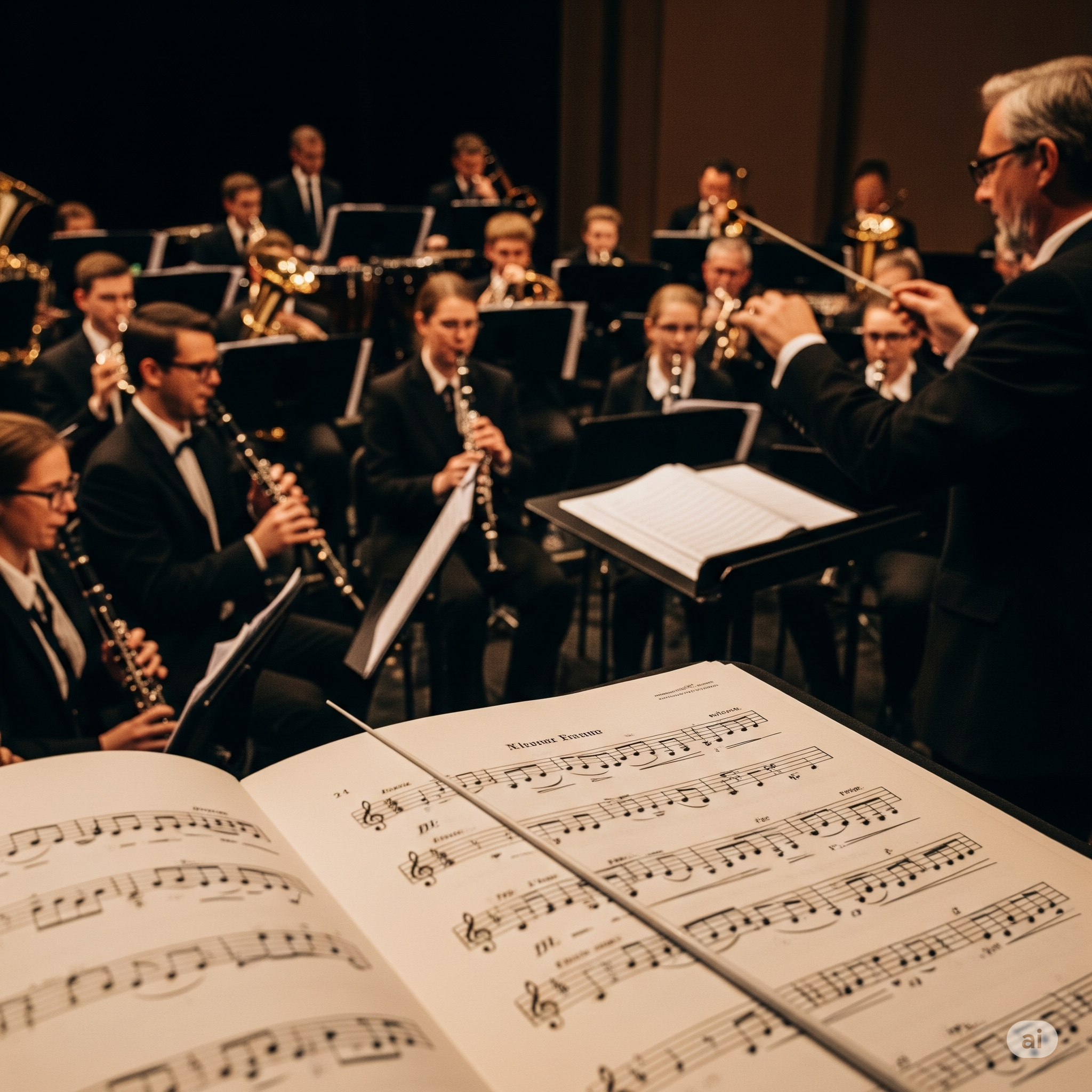
There are milestones in a composer's journey that stand out, moments where you feel a significant shift in your understanding and capabilities. For me, one of those truly unforgettable moments was writing my first piece for concert band.
Before this, my compositions were primarily for smaller ensembles – string quartets, piano pieces, maybe a vocal work or two. These were valuable experiences, certainly, but composing for a concert band felt like stepping onto a much larger, more colorful canvas. The sheer breadth of instrumentation – woodwinds, brass, percussion, all working in unison – presented both an exhilarating challenge and an incredible opportunity.
The idea for the piece came to me in a rush of inspiration. I remember sitting at my desk, thinking about the powerful resonance of a full ensemble, the layered textures, the potential for grand statements. Unlike smaller chamber works where every individual line is often exposed and intimate, the concert band offered a tapestry of sound, allowing for broad strokes and vibrant orchestral colors.
The process of writing was an adventure in itself. I spent hours poring over scores of established band literature, dissecting how composers like Holst, Grainger, and more contemporary figures managed to blend timbres, voice chords across different sections, and create compelling narratives with such a diverse group of instruments. It wasn't just about writing notes; it was about understanding the unique characteristics of each instrument – the bright clarity of the flutes, the warm depth of the clarinets, the stately power of the brass, the rhythmic drive of the percussion.
Orchestration, which had been a relatively minor concern in my chamber works, suddenly became paramount. How do you voice a chord so it sounds balanced and full? When do you double parts for added strength? How do you create contrast between sections? These questions dominated my thought process. There were moments of frustration, of course, where a passage didn't quite sound right in my head, or where I struggled to balance competing melodic lines. But these challenges were part of the learning process, pushing me to experiment and refine my ear for large ensemble writing.
Then came the moment of truth: the first rehearsal. Walking into the band room, seeing all those musicians with their instruments, knowing they were about to play my music – it was a mix of intense nerves and overwhelming excitement. The conductor raised the baton, and then… sound. My notes, my rhythms, my harmonies, suddenly filled the room, brought to life by dozens of talented musicians.
It wasn't perfect, of course. There were intonation issues, balance problems, and passages that needed clarification in the score. But hearing it, even in its raw form, was an incredible experience. The initial chords, the swells of melody, the powerful percussive hits – it was all there, tangible and real. That feeling of hearing your creation resonate through a full ensemble, of seeing musicians engage with the world you've built on paper, is truly unparalleled. It’s a moment every aspiring composer dreams of.
Writing that first concert band piece was more than just completing an assignment; it was a transformative experience. It expanded my compositional palette, deepened my understanding of instrumentation, and solidified my passion for creating music on a grander scale. It proved to me that the journey from a blank page to a resounding performance is one of the most rewarding paths a composer can take.